
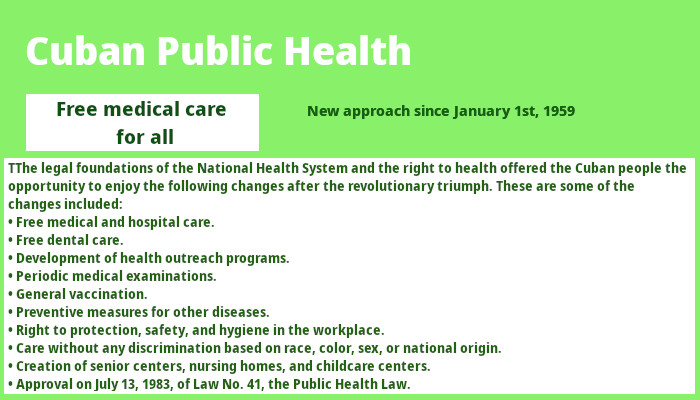
The triumph of the revolution in Cuba brought significant changes to the health of the people. From its inception, the public health system has evolved, always focused on being universal, free, and accessible to all, without discrimination. The Cuban Constitution and the Public Health Law uphold the right to medical care, emphasizing the importance of solidarity.
Over the decades, the system has undergone various transformations, such as the creation of family doctors and nurses, and the development of technologies. Since 2010, changes have been initiated to improve the health of the population, the quality of services, and the sustainability of the system. Specific needs have been identified, such as reorganizing health areas in small municipalities and improving the training of human resources.
These transformations have been accompanied by communication with the population and have taken into account the analysis of the health situation in each territory. The results have been positive: the infant mortality rate has remained below 5 per thousand, maternal mortality has also decreased, and life expectancy is 78 years.
Likewise, healthcare services have been improved, with an increase in the number of clinics and working groups. More than 67 million medical consultations were recorded, with an increase in visits by family doctors. The use of the clinical method has also been strengthened, and dependence on diagnostic tools has been reduced.
Care for infertile couples has continued, resulting in pregnancies. Rehabilitation services have been expanded, and resources in hospitals and social institutions have been strengthened. These efforts reflect an improvement in the health and satisfaction of the Cuban population.
The healthcare system’s trained workers who were in excess of the number of approved positions, which at the beginning of the process exceeded 52,000, are being reassigned according to the sector’s needs. This has involved 27,257 healthcare professionals and technicians. This is a necessary reserve to maintain the vitality of healthcare services. Specifically, 1,938 nurses and other professionals and technicians have been mobilized to bolster the skilled workforce in the capital. Among the examples of mobilizations in the provinces to address the shortage in the provincial capital is Holguín, where 103 nurses from other municipalities are providing services at the V.I. Lenin Clinical Surgical Hospital.
An additional 4,062 are being prepared and trained to serve as collaborators abroad, while 11,095 are currently fulfilling internationalist missions or replacing those already on such missions. These processes have been carried out based on the principle of demonstrated competence, accompanied by a series of organizational, guidance, and control measures. As a result, the sector has seen a decrease of more than 109,000 workers between the end of 2009 and 2013.