
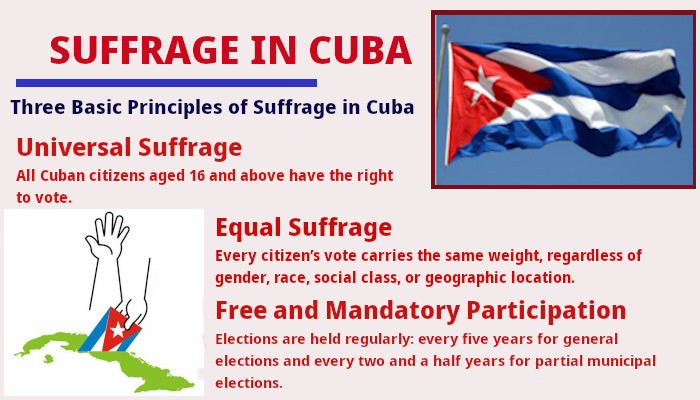
According to the Pan-Hispanic Dictionary of Legal Spanish (2022), suffrage is “the vote of one who has the capacity to elect.” It has been understood as a political right and, in recent years, as a right to participate. It is the right that recognizes its holder’s ability to be a subject in a given electoral process. It has a dual nature, that is, two possibilities for action: the power to elect (active suffrage) and the power to be elected (passive suffrage).
Active suffrage, under this same definition, is conceived as “the vote of one who has the capacity to vote” in elections—to elect—and to express their opinion in referendums, plebiscites, and recall elections. In the electoral sphere, active suffrage can be considered a right, and in other parts of the world, both a right and a legal duty.
This latter concept is based on the understanding that if a citizen does not go to the polls, it results in the demand for administrative accountability. This characteristic distinguishes it from its conception as a civic or moral duty, since the citizen feels identified with and committed to what has been submitted to an electoral process and, therefore, to the vote.
Passive suffrage, on the other hand, refers to those in whose favor a vote is cast, understood as “a person’s eligibility for office (…),” the possibility of being elected. It is the category used to identify those who can be elected and participate as candidates in elections for representatives and public offices, for which votes are cast in an electoral process.
Some of the requirements to consider include being a registered voter, having nationality or citizenship, and being of age; the latter varies depending on the responsibility that the elected official will hold, whether at the local or national level. The legal systems of different countries have requirements for the proper exercise of this right, based primarily on the acquisition of legal capacity for political discernment. in the territorial district where the elections will be held; and in compliance with certain formal requirements that legitimize the individual’s legal capacity to vote.
Specifically in Cuba, voting is a right of citizens recognized in Article 205 of the Constitution of the Republic and in Articles 4 and 5 of Law No. 127, the “Electoral Law.” It is regulated as free, because it is a right to exercise or not; secret, to ensure that one can express one’s own opinion, and therefore, equal; and the fact that it is direct allows the holder to participate in the selection of their representatives. These constitute basic principles that guarantee that the election results accurately reflect the will of the population, and each voter is entitled to only one vote; therefore, it is not a legal obligation.
This does not mean that Cubans do not feel obligated to go to the polls to exercise this right. Likewise, Cuban citizens, including members of the armed forces, who are at least sixteen (16) years of age, have been effectively resident in the country for a period of no less than two (2) years prior to the elections, are registered in the Electoral Registry, present their corresponding identity document at the polling station, and are in full enjoyment of their civil and political rights, without being subject to the exceptions provided for in the Constitution and the law, have the right to participate as voters in municipal and national elections, referendums, and plebiscites.
These provisions are legally supported by Article 7 of the Electoral Law. Cuban citizens, including members of the armed forces, who are in full enjoyment of their civil and political rights, have been effectively resident in the country for a period of no less than five (5) years prior to the elections, and are not subject to the exceptions provided for in the Constitution and the law, are entitled to be elected or to run for office. For the purposes of the Electoral Law, effective residence is determined by the citizen’s physical presence in the national territory or by acts that demonstrate their intention to remain there as their permanent domicile.
A Cuban citizen in full enjoyment of their civil and political rights may be elected as a delegate to the municipal assemblies, provided they have reached the age of sixteen (16), reside in an electoral district of the municipality, and have been nominated as a candidate therein. To be elected president or vice president of the Municipal Assembly of People’s Power, they must have previously been elected as a delegate to that assembly.