The theme of “How is public health in Cuba to salute the World Health Day” inevitably invites a complex analysis of one of the world’s most scrutinized medical systems. When Cuba addresses World Health Day (April 7), it does so through a dual lens: that of a nation striving to keep First World health statistics, and that of a country grappling with a profound Third World economic reality and the effects of the US economic blockade, which lately included sanctions to countries helping Cuba to acquire oil.
To salute World Health Day is, for Cuba, first and foremost to reassert its political commitment to health as a fundamental human right. Historically, the Cuban government uses this occasion to showcase its flagship achievements: an infant mortality rate that often rivals or exceeds that of wealthy nations, and a life expectancy that mirrors developed countries.
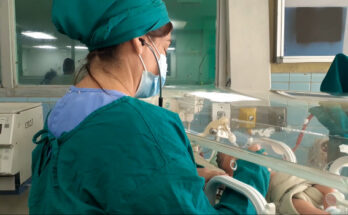
The salute is usually articulated through the prism of preventative medicine—the Family Doctor and Nurse program—which remains the backbone of their primary care strategy. In this context, the commentary focuses on the human element; the system’s greatest asset is not its technology, which is often outdated, but its sheer volume of trained medical personnel.
It should not be ignored that the geopolitical dimension. Cuba salutes World Health Day not just by looking inward, but by looking outward. Medical cooperation—doctors and nurses sent to Italy, Pakistan, and dozens of nations in the Global South—is central to the island’s identity. This medical cooperation is presented as a form of solidarity, in one hand, and in the other, it also serves as a vital economic engine. Cuba salutes the day, often highlighting this global footprint, framing the island as a world medical power despite its difficult economic situation.
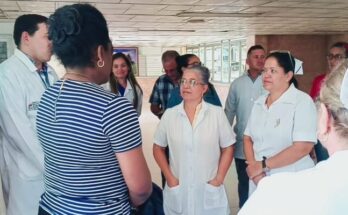
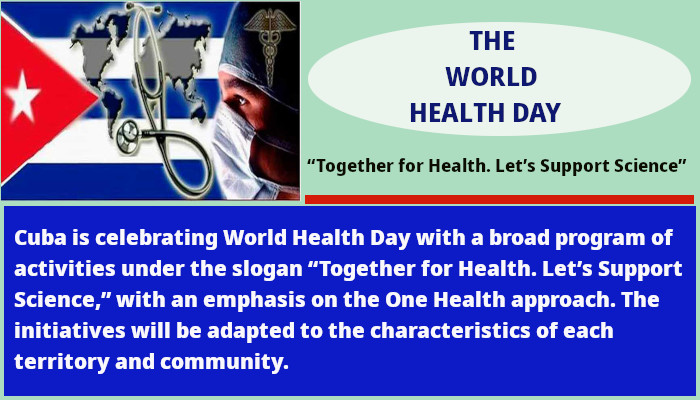
Cuba is celebrating World Health Day with a broad program of activities under the slogan “Together for Health. Let’s Support Science,” with an emphasis on the One Health approach. The initiatives will be adapted to the characteristics of each territory and community. The program was presented at a press conference at the PAHO/WHO Office in Cuba, with the participation of Dr. Iliana Morales Suárez,
Director of Science and Innovation at the Ministry of Public Health (MINSAP); Dr. Tatiana Durán Morales, Head of the Promotion Department of the Health Promotion and Disease Prevention Unit (Prosalud); and Dr. Mario Cruz Peñate, PAHO/WHO Representative in Cuba.
She also referred to important international events related to the date, such as the One Health Summit in France; A meeting of PAHO/WHO Collaborating Centers, where more than 800 leading institutions worldwide are convened to strengthen this scientific collaboration network; and the launch of a PAHO regional initiative aimed at accelerating the generation of evidence for the development of medicines and other health technologies.
It is important to emphasize that the Cuban science ecosystem integrates multiple organizations and more than 2,300 research projects, and it was noted that one of the main lessons learned from COVID-19 was the need to strengthen science and innovation as pillars of the health system. In this regard, it was explained that the Ministry of Public Health (MINSAP) promoted a program to improve the health system based on science and innovation, accompanied by a matrix of 103 innovations that have had a positive impact in recent years.
The commemoration of World Health Day in Cuba thus reaffirms the strategic role of science, innovation and intersectoral work to face current and future health challenges, in a context where protecting the health of people also implies caring for the health of animals, plants and the environment.