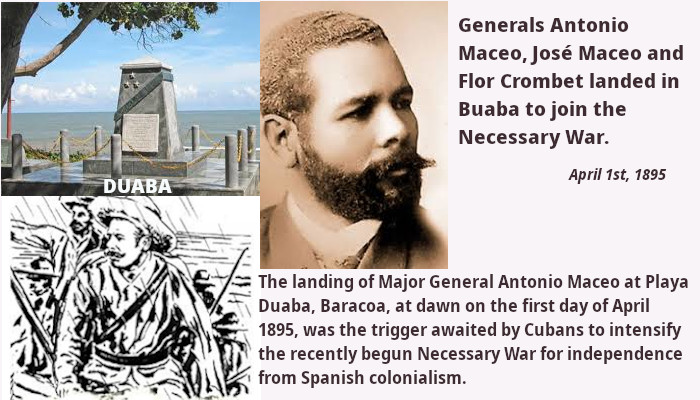
The arrival of General Antonio Maceo in Cuba through Duaba on April 1, 1895, holds profound significance in the history of the War of Independence, officially begun with the Grito de Baire (Cry of Baire) on February 24, 1895. This act was not merely the physical entry of a military leader; it represented hope, unity, and the continuation of an interrupted struggle.
First, Maceo’s figure symbolized military experience and prestige. Known for his bravery and strategic skill in previous wars, his arrival bolstered the morale of the insurgents and lent credibility to the new insurrection. For the men and women who remembered his role in past campaigns, his return meant that the struggle had leadership capable of confronting the colonial army.
Furthermore, his arrival through Duaba held strong symbolic and practical value. Duaba, in eastern Cuba, was a traditional meeting point for the Mambises (Cuban independence fighters); Entering through that route connected the new war with previous struggles and leveraged local support networks, knowledge of the terrain, and communication routes. This facilitated the initial organization of forces and the redistribution of resources in a challenging environment.
Politically, Maceo lent legitimacy to the independence movement. His presence tended to unite different factions of the rebellion, dispel internal doubts, and attract both civilian and military support. In a context where coordination was key to sustaining a prolonged war, the leadership of recognized figures helped consolidate a common direction and prevent fractures that would have weakened the cause.
From a moral and symbolic standpoint, Maceo’s arrival fueled popular enthusiasm. Accounts of his entry spread among the population as tangible proof that independence was possible and that determined leaders were willing to risk everything. This narrative helped maintain the resistance and secure recruits and vital supplies for the war.
Finally, Maceo’s arrival marked the historical continuity of the Cuban independence movement, linking the memory of past struggles with the new stage that began in 1895. His presence served as a bridge between generations of fighters and a reminder that the fight for freedom remained a national cause.
In short, Antonio Maceo’s arrival in Duaba on January 1, 1895, represented a military and moral reinforcement, a source of political legitimacy, and an element of historical continuity that decisively contributed to the initial momentum of the War of Independence.