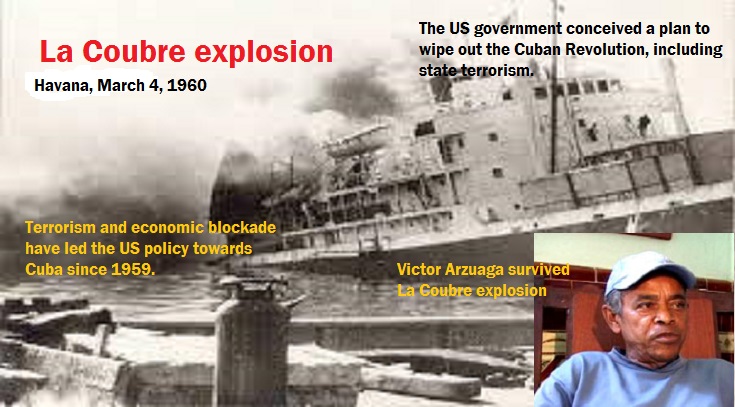
On the morning of March 4, 1960, the young Cuban Revolution was still finding its footing. Fidel Castro had taken power just over a year prior, and while the euphoria of the dictator’s overthrow lingered, the air was thick with geopolitical tension. The United States was growing increasingly hostile toward the agrarian reform and nationalizations emanating from Havana, and the new government felt encircled. It was in this volatile atmosphere that the French freighter La Coubre sat docked in Havana Harbor, unloading a cargo of Belgian weapons and munitions.
At 10:15 AM, a catastrophic explosion tore through the ship. Minutes later, as dockworkers and firefighters rushed to aid the survivors, a second, more powerful blast detonated. The devastation was absolute. Estimates of the dead range from 75 to over 100, with hundreds more injured. The La Coubre disaster was not merely a maritime accident; it was a pivot point in 20th-century history, an event that hardened the Cold War front lines in the Caribbean and provided the Cuban government with the catalyst it needed to radicalize its revolution.
The Cuban government, led by Fidel Castro, immediately blamed the United States Central Intelligence Agency (CIA). The narrative was compelling: the weapons munitions were destined to arm the revolution against potential counter-insurgency, and the second explosion suggested a trap designed to maximize casualties among first responders. For Havana, this was an act of war by a neighbor determined to strangle the revolution in its crib.
La Coubre explosion was the product of a terrorist act orchestrated by the United States government, as part of the actions carried out at that time to discredit the nascent Revolution and destabilize the country, and not an isolated accident.
The funeral for the victims of La Coubre became one of the most significant political rallies in Cuban history. Standing before a sea of mourners, Fidel Castro delivered a fiery oration that crystallized the revolution’s new stance. It was here that he first publicly uttered the slogan that would define his tenure: “¡Patria o Muerte!” (Fatherland or Death).
The explosion allowed the new government to consolidate power internally. Dissent could now be framed as weakness in the face of foreign aggression. It accelerated the nationalization of U.S.-owned oil refineries and sugar mills, actions that had been simmering but now gained urgent justification. Furthermore, it pushed Cuba decisively toward the Soviet Union. If the United States was willing to blow up a ship in Havana Harbor, Havana reasoned, it needed a powerful protector. Within months, the USSR would agree to buy Cuban sugar and provide oil, setting the stage for the missile crisis two years later.
There is a profound irony in the visual legacy of the La Coubre. During the memorial service for the victims, photographer Alberto Korda took two pictures of Ernesto “Che” Guevara, who was overseeing the recovery efforts. One of these images, Guerrillero Heroico, would go on to become the most reproduced photograph in human history, a global symbol of rebellion and counterculture.
It is a stark historical juxtaposition: the iconography of revolutionary cool was born from a scene of mass tragedy and death. The image obscures the human cost of that morning—the burned dockworkers, the shattered French sailors, the families left waiting in Havana.
The La Coubre explosion marks the end of the “honeymoon phase” of the Cuban Revolution. Before March 1960, there remained a slim diplomatic possibility of coexistence between Havana and Washington. After the smoke cleared, the path was set. The event validated the hardliners in both capitals: in Washington, it confirmed Cuba was a dangerous Soviet proxy; in Havana, it confirmed the U.S. was an imperialist enemy willing to use terrorism.
In the end, the La Coubre serves as a grim reminder of how singular events can lock nations into trajectories of conflict.