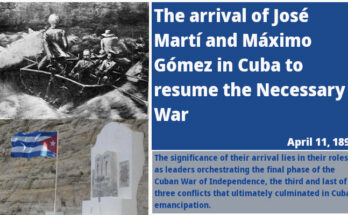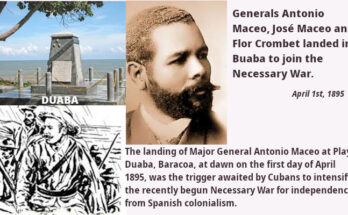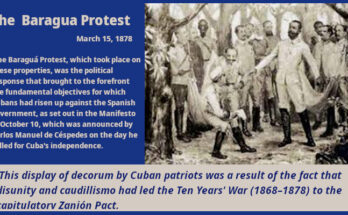
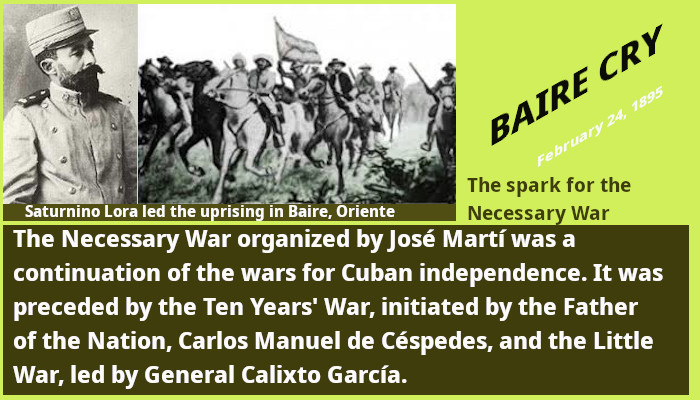
As day broke, a representative group from Santiago de Cuba attended the military changing of the guard ceremony at the mausoleums of national heroes, whose remains rest in the Santa Ifigenia Historic Cemetery, commemorating the 131st anniversary of the beginning of the Necessary War, organized by José Martí, the Apostle of Independence.
The event—conducted by cadets and students from the Inter-Arms School of the Revolutionary Armed Forces, as well as from the Antonio Maceo Order, the José Maceo Grajales Order, and the Camilo Cienfuegos Military School in Santiago de Cuba—culminated with the laying of a wreath on behalf of the Cuban people at the José Martí Mausoleum. Flowers were also scattered in homage to the Father and Mother of the Nation, Carlos Manuel de Céspedes and Mariana Grajales Cuello, respectively, and at the monolith that holds the ashes of Commander-in-Chief Fidel Castro Ruz, who continued and led the success of the only Cuban Revolution.
Political and government officials from the indomitable province, along with chiefs and officers of the Revolutionary Armed Forces and the Ministry of the Interior, as well as representatives from social organizations, led this tribute—always accompanied by the melodies of Versos Sencillos and other patriotic compositions performed by the Eastern Army Band—which was joined by the attendees.
Of the 35 towns where the cry of “Independence or Death!” resounded on February 24, 1895, several are located in the province of Santiago, and in Baire—a place that has become a symbol of the rebirth—Beatriz Johnson Urrutia, member of the Central Committee and First Secretary here, presided over the main event in the area to commemorate the date.
In the emblematic town, the Mambí bugle call sounded once again, and its inhabitants marched from Revolution Park—where Saturnino Lora called for the fight for freedom—to the cemetery where several independence fighters rest.
Young people experienced a special connection with history in Baire, as well as in San Lorenzo (Third Front) and Santa Ifigenia, “because we are the continuers and defenders of Martí’s legacy and this Revolution led by Fidel Casro, at a time when imperialist aggression is increasing,” noted Juan Yunior Castellano Menéndez; “to do otherwise would be to betray the glory we have lived,” affirmed student Olga Elena Ortega Jiménez.
Furthermore, in Alto Songo, the work of Guillermón Moncada was commemorated; in San Luis, Quintín Banderas; in El Cobre, Alfonso Goulet; Victoriano Garzón in El Caney; as well as Félix Cayamo and Manuel La O Jay, who rose up in Palma Soriano.
(Source: Granma)