
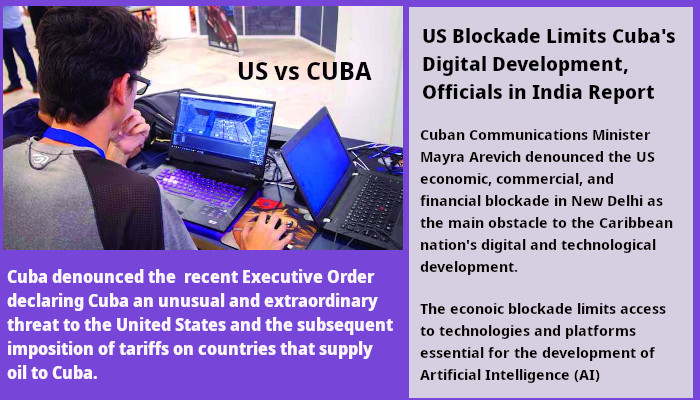
Cuban Communications Minister Mayra Arevich denounced the US economic, commercial, and financial blockade in New Delhi as the main obstacle to the Caribbean nation’s digital and technological development.
It limits access to technologies and platforms essential for the development of Artificial Intelligence (AI) and compromises the energy sustainability of the country’s digital infrastructure, Arevich stated at the AI Impact Summit, the first of its kind held in a country of the Global South.
She referred to the recent Executive Order declaring Cuba an unusual and extraordinary threat to the United States and the subsequent imposition of tariffs on countries that supply oil to Cuba.
“This is a new and serious attack against our sovereignty. It is economic warfare, a genocidal act that attempts to punish the entire Cuban population, generate internal disintegration, and endanger the lives of millions of Cubans,” she emphasized.
In this regard, the Cuban Minister strongly condemned the application of unilateral coercive measures, which violate international law and, she added, undermine development, peace, and global progress, preventing the transformative power of AI from truly serving all of humanity.
The Cuban Minister of Communications added that the potential of Artificial Intelligence will only be realized if we overcome the structural inequalities of the current unjust and undemocratic international economic order.
She called for prioritizing strategies and regulations for the ethical and responsible use of AI, adapted to our contexts and values, given the technological disparities and digital divides that disproportionately affect the Global South.
Arevich affirmed that Cuba defends open, compatible, and non-discriminatory international standards and considered South-South cooperation key to building shared capabilities and breaking down technological asymmetries.
She reaffirmed her country’s categorical rejection of the use of AI for criminal or terrorist purposes, or for interference in the internal affairs of our states, including the manipulation of history and sovereignty.
The Cuban Minister gave examples of the island’s policies regarding this technology, such as the approval, in 2024, of the strategy for its development and use. She explained that Cuban universities and companies are already developing applications in health, agriculture, education, disaster management, and other sectors, with a humanistic approach.
She also noted that curricula at all educational levels are being updated to train professionals skilled in AI, with a strong ethical conscience and responsibility.
“This progress is being achieved despite the unjust economic, commercial, and financial blockade imposed by the United States government for more than six decades,” she emphasized.
Arevich added that the collective challenge is to ensure that the development and use of Artificial Intelligence translates into well-being for all, without exclusion, and that technological opportunities are widely shared among all regions.
Finally, she reaffirmed Cuba’s commitment to collaborate in this endeavor, convinced that only with solidarity – above the selfishness of geopolitical and corporate interests – can a just and humane digital future be built.