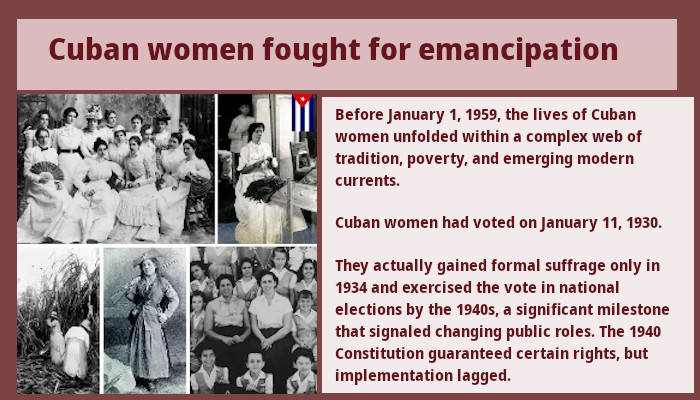
Before January 1, 1959, the lives of Cuban women unfolded within a complex web of tradition, poverty, and emerging modern currents. The island’s social structure placed heavy weight on family, church, and patriarchal norms, shaping daily life and long-term prospects for most women. Yet beneath the surface of expected roles, women navigated constrained choices with resilience: running households, sustaining communities, and quietly carving spaces for ambition and resistance.
Most Cuban women lived in urban barrios or rural villages where family duty defined adult identity. Marriage and motherhood were presented as natural endpoints; daughters were taught domestic skills, while sons were groomed for public life. A woman’s social worth was often measured by her ability to maintain the home, raise children, and uphold moral respectability. This expectation limited formal education and career paths for many. Primary schooling was widespread enough for basic literacy, but secondary and higher education remained less accessible to women, especially in poorer and rural families where economic necessity prioritized boys’ schooling.
Economic realities placed additional burdens on women. Wages were low and employment opportunities narrow. Middle- and upper-class women could find work as secretaries, teachers, nurses, or in small businesses, but the working class faced harsher options: domestic service, factory labor in sugar mills, or intermittent agricultural work. Domestic service, in particular, reinforced class and gender hierarchies; many young women left the countryside for cities to become maids, living in employers’ homes and subject to long hours and limited protections. Those in industrial or plantation settings faced dangerous conditions, seasonal work fluctuations, and minimal labor rights. A woman supporting her family had to balance paid work with unpaid domestic labor, an often invisible second shift.
Although Cuban women had voted on January 11, 1930, Legal and political rights offered a mixed picture. They actually gained formal suffrage only in 1934 and exercised the vote in national elections by the 1940s, a significant milestone that signaled changing public roles. The 1940 Constitution guaranteed certain rights, but implementation lagged. Divorce was legally possible after earlier reforms, yet social stigma persisted. Family law still favored male authority within households, and patriarchal customs influenced inheritance and guardianship. Politically active women formed organizations and engaged in reformist movements, but their leadership was frequently marginalized in male-dominated parties. Local women’s clubs and mutual aid societies became key venues for social engagement, charity work, and modest advocacy on education and health.
Healthcare and reproductive realities shaped women’s lives in profound ways. Maternal mortality remained a pressing issue for poorer communities, where access to hospitals and trained midwives was uneven. Family planning services were limited and often stigmatized; contraception was not widely available and abortion was heavily restricted, pushing many to risky procedures. These gaps affected not only physical health but also economic and social mobility, as repeated childbirth without support trapped families in cycles of poverty.
Race and class cut across women’s experiences, creating layers of inequality. Afro-Cuban women faced compounded discrimination: they were more concentrated in low-paid jobs, had less secure housing, and encountered prejudice in public and private spheres. Racialized beauty standards and social exclusion also affected marriage prospects and career opportunities. Conversely, white, urban women from wealthier families enjoyed greater educational access and social freedoms, yet they too were constrained by norms of propriety and expectation. Mixed-race and working-class neighborhoods became spaces where cultural resilience flourished—music, religion, and mutual aid networks sustained communities and opened informal pathways for women’s leadership.
Cuban women engaged in social and political movements in ways that revealed both constraint and agency. Women participated in labor strikes, anti-imperialist protests, and nationalist campaigns. In cities, female organizers helped mobilize workers and tenants; in rural areas, women joined peasant struggles for land and fair wages. Revolutionary rhetoric of the 1950s, increasingly widespread as political conflict intensified, appealed to many women’s sense of injustice. Some women joined clandestine movements, served as couriers, or sheltered activists; others contributed by organizing local relief and education endeavors. These actions often went unacknowledged in official histories, yet they demonstrated women’s essential roles in shaping public life.
Cultural life offered both consolation and subtle empowerment. Music, religion, and family rituals preserved identity and solidarity. Women were central to domestic culture—preparing food, maintaining traditions, and transmitting language and values across generations. At the same time, Cuban literature and journalism began to reflect women’s voices more directly, with female writers and journalists addressing social inequality, family tensions, and the desire for autonomy. Popular culture, radio dramas, and theater sometimes reinforced stereotypes, but they also created platforms where women’s concerns could be aired and debated.
As the 1950s progressed, the social landscape grew more fraught. Political violence, economic instability, and growing polarization affected women’s everyday security. Urban neighborhoods experienced raids and reprisals; rural women bore the impact of land disputes and forced displacements. The insecurity deepened the urgency of demands for reform—better healthcare, land rights, labor protections, and educational access—that many women supported and sometimes led.
Before January 1, 1959, Cuban women lived at the crossroads of deep-rooted traditions and rising calls for change. Constrained by gendered expectations, economic hardship, and racial hierarchies, they nonetheless sustained families, shaped communities, and contributed to public life in vital ways. Their stories are those of endurance and quiet resistance—found in the labor of city maids and sugarcane workers, the organizing of political activists, the leadership of local mutual aid groups, and the cultural work of mothers and artists—setting the stage for the profound social transformations that would soon sweep the island.