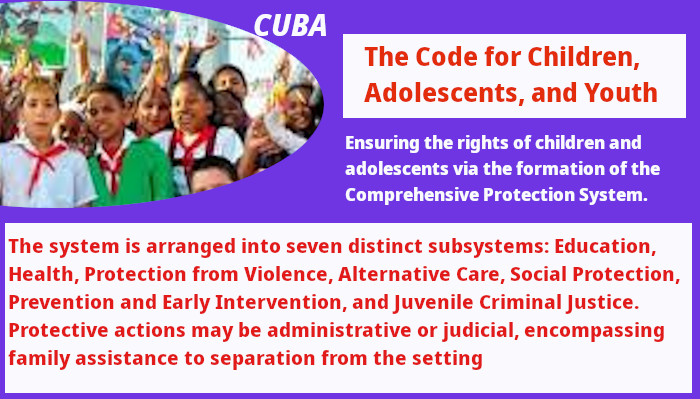
The implementation of the Children, Adolescents, and Youth Code (Law 178/2025) has established an institutional framework in Cuba aimed at ensuring the rights of children and adolescents via the formation of the Comprehensive Protection System, according to Granma newspaper.
The updated framework addresses the 2019 constitutional requirement and the 2022 Family Code, acknowledging new generations as complete rights holders and creating mechanisms to enforce those rights.
One of its core principles is viewing children as developing persons in need of special protection, with a collective obligation from families, educational institutions, and government bodies to create inclusive and safe environments free from violence.
The system is arranged into seven distinct subsystems: Education, Health, Protection from Violence, Alternative Care, Social Protection, Prevention and Early Intervention, and Juvenile Criminal Justice, each serving particular roles to tackle the various aspects of children’s and young individuals’ lives.
In the realm of violence, the system offers support services, legal aid, and psychological care, along with required protocols in institutions for identifying, reporting, and monitoring cases.
Alternative care ensures the right to reside in a family setting via options like foster care or institutional care, with the latter being an exceptional and temporary measure, always determined by a judicial decision.
Juvenile criminal justice emphasizes restorative and socio-educational approaches rather than punitive measures, explicitly banning the death penalty and life sentences, and ensuring separation from adult correctional facilities.
Protective actions may be administrative or judicial, encompassing family assistance to separation from the setting, always as a last resort, ensuring the child’s voice is considered and involving professionals and support teams.
National leadership is held by the Commission on Children, Adolescents, and Youth, led by a deputy prime minister and made up of the leaders of the provincial level, governors lead the commissions, while at the municipal level, emphasis is placed on identifying risks and handling complaints and reports, ensuring coordinated efforts across all levels.
This institutional structure signifies a crucial advancement in the thorough safeguarding of children in Cuba and sets up mechanisms for oversight and regular assessment to ensure its efficacy.
(Source; ACN)