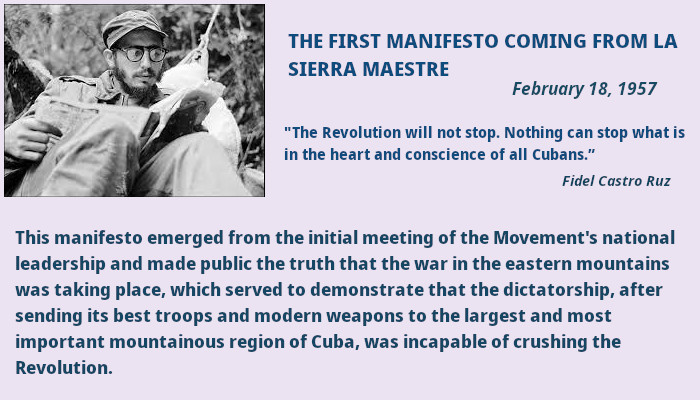
On February 18, 1957, Fidel Castro issued the M-26-7 Manifesto to the people of Cuba, marking a crucial moment in the Cuban revolutionary struggle. This document, drafted from the Sierra Maestra mountains, became the first programmatic declaration of the Movimiento 26 de Julio (M-26-7), laying out the ideological foundations and political vision of the insurgent movement against Fulgencio Batista’s dictatorship.
A determination came out of this revolutionary document as Fidel Castro stated: “The Revolution will not stop. Nothing can stop what is in the heart and conscience of all Cubans.”
By the mid-1950s, Cuba was under the authoritarian rule of Fulgencio Batista, whose government was marked by corruption, repression, and close ties to U.S. economic interests.
After the failed Moncada Barracks attack in 1953 and subsequent exile in Mexico, Fidel Castro and his followers returned to Cuba aboard the Granma yacht in December 1956. Despite heavy losses, the survivors regrouped in the Sierra Maestra mountains, where they began organizing guerrilla warfare.
To consolidate support and articulate a clear revolutionary vision, the young leader drafted the manifesto as a unifying call to action.
The M-26-7 Manifesto outlined:
Commitment to Democracy: It pledged to restore constitutional order, reinstate civil liberties, and hold free elections once Batista was overthrown.
Social Justice Goals: The document emphasized land reform, fair wages, and improved living conditions for peasants and workers.
National Sovereignty: It denounced foreign exploitation and called for Cuba’s economic independence.
Unity of the Opposition: Recognizing the dangers of political fragmentation, Castro urged unity among revolutionary forces to defeat tyranny.
Unlike earlier proclamations, this manifesto was issued directly from the guerrilla stronghold, symbolizing the resilience and growing legitimacy of the movement. It served as a rallying cry, attracting peasants, students, and intellectuals to the revolutionary cause.
Many of the principles outlined later became central to the Cuban Revolution’s policies after 1959.
Legacy. The M-26-7 Manifesto remains a landmark in Cuban history. It not only articulated the aspirations of a revolutionary generation but also set the stage for the eventual triumph of the Cuban Revolution in January 1959. Its emphasis on democracy, sovereignty, and social justice continues to be studied as a defining moment in Latin American revolutionary thought.