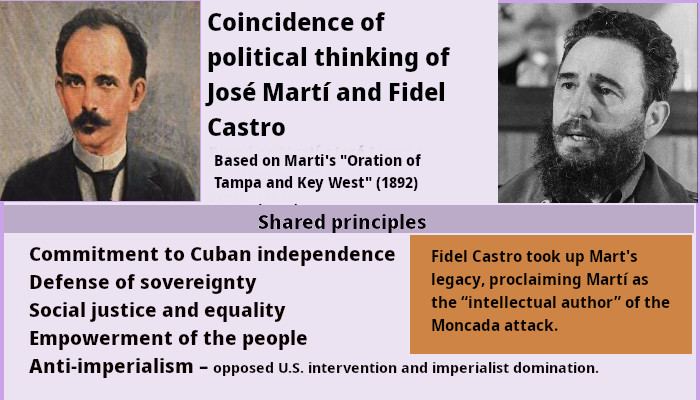
José Martí’s “Oration of Tampa and Key West” (1892) and Fidel Castro’s political thought share a profound convergence in their vision of independence as a comprehensive project of social justice and national unity.
Martí insisted that independence should be the work of all Cubans, both on and off the island, without divisions based on class or region. Fidel took up this idea, conceiving the Revolution as a broad popular movement where workers, peasants, students, and intellectuals were integrated into a single project. For both, revolutionary unity was crucial.
Martí saw independence not only as a break with Spain but also as a guarantee of sovereignty against any foreign power. Fidel extended this vision by denouncing imperialism and defending Cuba’s self-determination against the United States, thus guaranteeing full independence for the nation.
Martí linked independence to the dignity of the migrant worker, such as the cigar makers of Tampa and Key West. Fidel broadened that perspective by placing social justice—education, health, equality—at the heart of the revolutionary project.
The “Tampa and Key West Prayer” was a call for unity and moral commitment to the homeland. Decades later, Fidel Castro took up that legacy, proclaiming Martí as the “intellectual author” of the Moncada attack and as the spiritual guide of the Revolution. Both conceived of independence as a process inseparable from social justice and human dignity.