The intricate tapestry of Cuban history during the late 19th century is woven with threads of conflict, hope, and aspirations for sovereignty. Two crucial events that encapsulate the struggle for independence and the complexities of political negotiations are the Baraguá Protest and the Pact of Zanjón. These moments not only illustrate the fervor of the Cuban liberation movement but also the intricate dynamics between revolutionary aspirations and political pragmatism.
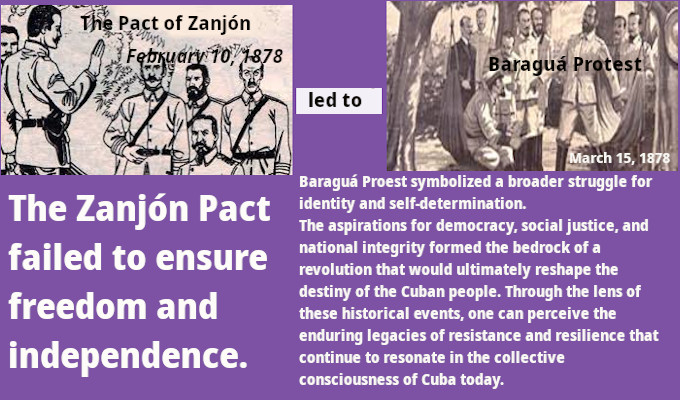
The Pact of Zanjón, signed on February 10, 1878, marked a significant yet controversial moment in Cuba’s quest for independence from Spanish colonial rule. After nearly a decade of warfare known as the Ten Years’ War, the Cuban insurgents found themselves facing tremendous challenges such as division and pessimism within the insurgent forces.
The pact, negotiated between General Arsenio Martínez Campos, representing the Spanish government, and several prominent leaders of the uprising. However, the terms of the agreement were met with mixed reactions; while it promised certain concessions, such as the abolition of slavery and autonomy, but it failed to ensure many felt that it fell short of the true aspirations for complete independence.
In stark contrast to the acceptance of the Pact of Zanjón by some factions of the rebel leadership, the Baraguá Protest emerged as a powerful declaration of resistance against what was perceived as a betrayal of the revolutionary cause. Occurring shortly after the signing of the pact, the Baraguá Protest was led by the legendary insurgent leader Antonio Maceo, who was vehemently opposed to the treaty’s terms. Maceo, known for his fierce commitment to the principles of freedom and equality, regarded the pact as an inadequate compromise that failed to address the root causes of Cuba’s plight under colonial rule. His discontent was not merely personal; it resonated with a significant portion of the population and the revolutionary fighters who had endured years of hardship and bloodshed in pursuit of their ideals.
On March 15, 1878, in the rugged terrains of Baraguá, Maceo formally declared his rejection of the Pact of Zanjón. The protest was not simply an act of defiance; it symbolized a broader struggle for identity and self-determination. Maceo’s rallying cry underscored the sentiment that while some may have been willing to compromise, true freedom would require steadfast determination and resilience. His refusal to accept the pact ignited a renewed sense of purpose among those who yearned for a more comprehensive solution—one that unequivocally embraced the notion of Cuban independence rather than mere autonomy under colonial oversight.
The implications of the Baraguá Protest rippled through the fabric of the Cuban independence movement. It highlighted the ideological rift within the revolutionary forces, where differing visions of liberty clashed. While the Pact of Zanjón sought to bring a semblance of peace, Maceo and his supporters emphasized that true freedom could only be achieved through continued struggle. This divergence would later influence the course of subsequent uprisings, culminating in the War of Independence that erupted in 1895.
The relationship between the Baraguá Protest and the Pact of Zanjón serves as a profound illustration of the complexities that defined Cuba’s fight for independence. The protests led by Antonio Maceo embodied the unyielding spirit of a nation reluctant to settle for half-measures in its pursuit of freedom.
As history recounts this chapter, it becomes evident that the aspirations for democracy, social justice, and national integrity formed the bedrock of a revolution that would ultimately reshape the destiny of the Cuban people. Through the lens of these historical events, one can perceive the enduring legacies of resistance and resilience that continue to resonate in the collective consciousness of Cuba today,