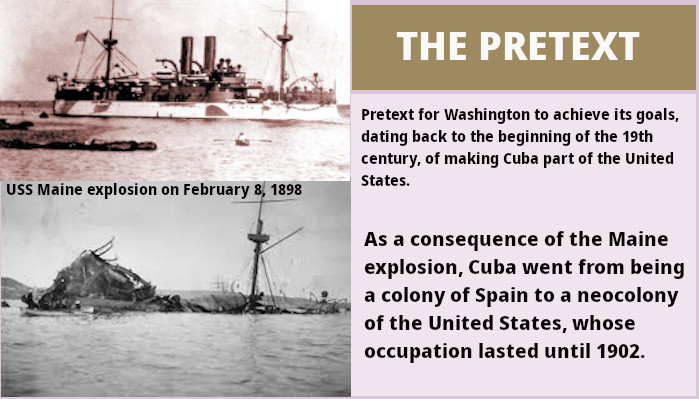
On February 8, 1898, the United States government put into practice the final stage of its plan to find a pretext to justify its intervention in Cuba’s last war of independence. They deliberately planned something tragical and cruel.
At 9:40 p.m. on February 15, 1898, the explosion of the battleship Maine in Havana harbor, where it had been on a “friendly visit” since January 25 despite the strained relations between the United States and Spain at that time, served as a pretext for Washington to achieve its goals, dating back to the beginning of the 19th century, of making Cuba part of the United States.
When the “ripe fruit” theory emerged in 1823 and the Monroe Doctrine of “America for the Americans” was adopted in the United States, its ambitions regarding Cuba had already involved six attempts to purchase the island from Spain, a decade of annexationist pressure, and a failure to recognize the belligerent role of the Cubans in their struggle against Spanish colonialism.
None of those actions had yielded the expected results, and with the Mambí victory anticipated very soon, the “ripe fruit” would be lost forever. The mafia-like thinking of the Washington strategists then led them to fabricate a pretext by sacrificing three-quarters of the 354 crew members of the battleship who perished in the explosion.
Its crew consisted of 26 officers and 328 enlisted men. Among the latter were numerous immigrants, although almost all were already U.S. citizens or permanent residents in the process of obtaining citizenship. It is not true, as has sometimes been claimed, that the majority of the crew were Black. Credible sources state that Black people comprised less than a fifth of the crew.
As has become customary with subsequent US interventions in Grenada, Iraq, Libya, and many other countries, the US press reacted immediately, accusing Spain of having blown up the ship with a mine from the outside, splitting it in two at the bow, and demanding a “forceful” response from the United States.
Subsequent scientific investigations demonstrated that the explosion was of internal origin, but Cuban historian Gustavo Placer Cervera concludes in his book on the subject that, whatever its origin, the historical significance of this event lay in its manipulation to turn it into a pretext justifying the opportunistic US intervention in Cuba.
The explosion claimed the lives of 261 US Marines, but almost all of the 26 officers survived because they had gone ashore. The yellow press in the United States—controlled by Joseph Pulitzer and Randolph Hearst—justified the need for military intervention in the conflict and began directly accusing Spain of causing the explosion.
This media campaign led, in a matter of days, to the sought-after declaration of war against Spain in 1898, the approval of the deceptive Joint Declaration, and the start of the so-called Spanish-Cuban-American War, in which the Cuban rebels (Mambises) were prevented from entering Santiago de Cuba, and thwarted 30 years of armed struggle for independence.
As a consequence of the Maine explosion, Cuba went from being a colony of Spain to a neocolony of the United States, whose occupation lasted until 1902.
In 1911, the wreck of the Maine was refloated to recover the bodies of the victims and to tow the hull, which was blocking the entrance to Havana harbor, four miles out to sea. The United States never allowed an international commission to inspect the ship’s remains. But in 1978, American experts, led by Admiral H.G. Rickover, reviewed the report and published a new opinion stating that the explosion was accidental and caused from within by spontaneous combustion of the coal.
A pretext similar to the sinking of the Maine was attempted again in 1962 to overthrow the nascent Cuban Revolution led by Fidel Castro. This is evidenced by a secret document declassified in 1997, which stated verbatim: “A series of well-US Planning a Pretext to intervene in the Cuban-Spanish War