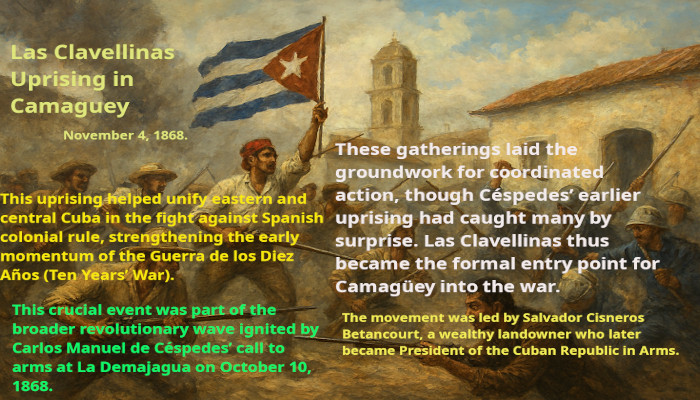
Even though the wars for the independence of Cuba started in Oriente (Former eastern province of Cuba) other regions joined the wars, so was the case of Las Clavellinas Uprising on November 4, 1868 in Camagüey province. It marked the region’s entry into Cuba’s Ten Years’ War for independence.
This crucial event was part of the broader revolutionary wave ignited by Carlos Manuel de Céspedes’ call to arms at La Demajagua on October 10, 1868. While Céspedes’ uprising began in Oriente, Las Clavellinas signaled Camagüey’s commitment to the cause.
The movement was led by Salvador Cisneros Betancourt, a wealthy landowner who later became President of the Cuban Republic in Arms.
The Junta Revolucionaria de Camagüey coordinated the uprising, gathering 76 insurgents who marched to the sugar mill El Cercado, owned by Martín Castillo Agramonte
The rebels formed seven platoons, each led by figures like Ignacio Mora de la Pera and Manuel Ramón Silva. Jerónimo Boza Agramonte was appointed military chief of Camagüey, supported by Gregorio Boza.
This uprising helped unify eastern and central Cuba in the fight against Spanish colonial rule, strengthening the early momentum of the Guerra de los Diez Años (Ten Years’ War).
The uprising was preceded by three key meetings among Camagüey’s revolutionary leaders:
- At La finca de Rubalcava
- At Los Caletones
- On August 4, 1868, near Camagüey
These gatherings laid the groundwork for coordinated action, though Céspedes’ earlier uprising had caught many by surprise. Las Clavellinas thus became the formal entry point for Camagüey into the war.
If you’re exploring revolutionary networks across Cuba, I can help map out how Las Villas joined the fight later—or create a visual timeline of regional uprisings. Would you like that in Spanish or bilingual format?