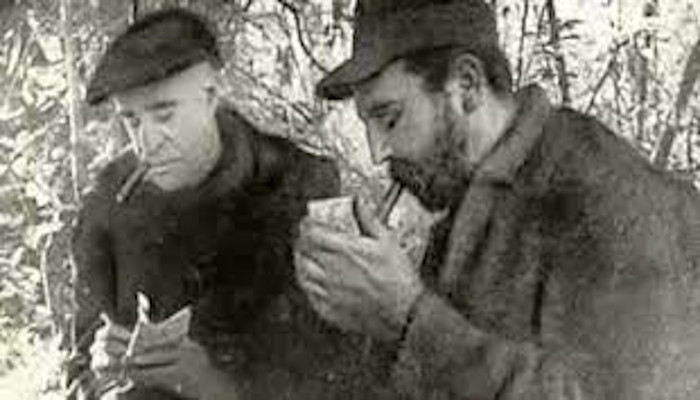
On February 16, 1957, the American journalist Herbert Matthews contacted Fidel Castro whom he interviewed the following day in the rugged terrain of La Sierra Maestra, a mountainous region in Cuba that served as a stronghold for Castro and his revolutionary forces. This encounter was crucial to not only for the relationship between the United States and Cuba but also for the global perception of the Cuban Revolution.
Feeling unable to defeat the Revolution by force of arms, the Batista tyranny resorted to the most cowardly lies, announcing the extermination of the expeditionary detachment and its leader. The official authorities claimed that Mathews had invented Fidel Castro.
Matthews, known for his insightful reporting, sought to understand Castro’s motivations and the broader implications of the revolutionary movement that was gaining momentum against the Batista regime. The interview took place amidst the backdrop of a fierce struggle for power, with Castro’s guerrilla fighters challenging the established government, which was corrupt and oppressive.
During the interview, Matthews engaged the young leader in a dialogue that revealed the latter’s ideological convictions and aspirations for Cuba. Castro articulated his vision of a more equitable society, emphasizing themes of social justice, anti-imperialism, and national sovereignty.
The journalist’s probing questions allowed Fidel Castro to express his disdain for the existing political order and his commitment to reforming the country through revolutionary means. This exchange not only provided insights into Castro’s character and leadership style but also highlighted the complexities of the political landscape in Cuba at the time.
Matthews’ reporting on this interview would later influence public opinion in the United States, as many began to view Castro as a charismatic leader rather than merely a rebel.The significance of this interview extended beyond the immediate context of the Cuban Revolution. It marked a turning point in how the American media portrayed revolutionary figures and movements in Latin America. Matthews’ portrayal of Castro as a determined and principled leader resonated with many readers, challenging prevailing narratives that depicted such figures solely as threats to stability.
This shift in perspective contributed to a growing interest in the dynamics of Cold War politics in the region, as well as the complexities of U.S.-Cuban relations. Ultimately, the interview served as a crucial moment in the historical narrative of Cuba, shaping both domestic and international discourse surrounding the revolution and its aftermath.