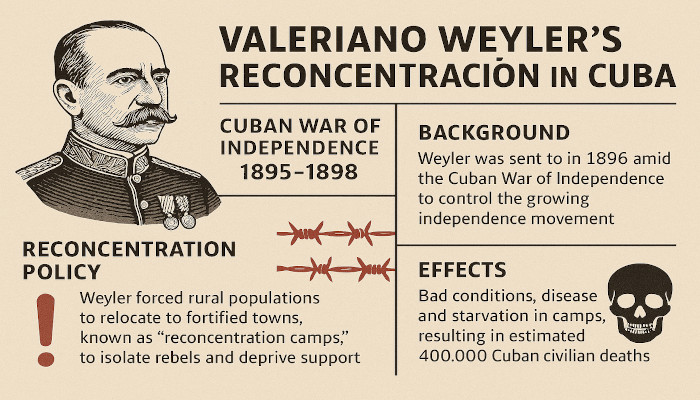
In 1896, Valeriano Weyler became governor of Cuba. He was a Spanish general known for his iron fist. He launched the reconcentration policy, ordering all rural people to relocate to controlled urban areas.
The plan aimed to isolate civilians from the Mambises, the Cuban guerrillas fighting for independence. This cut off the rebels’ food supplies and hiding places.
This military strategy sounded simple at first, but it hit the peasants hard. It forced thousands of families to abandon their farms, crops, and livestock. Without their land, they faced acute hunger. They crowded into makeshift neighborhoods with little water and sanitation. The filthy conditions helped diseases spread like wildfire.
Epidemics of malaria, dysentery, and typhus broke out. Without doctors or medicine, death claimed lives daily. Healthy peasants succumbed within weeks from weakness and fever. The people forced into forced labor lived in palm-thatched huts or in the open air. Children and the elderly suffered the most. Entire families were torn apart by the chaos.
The lack of raw food led to malnutrition. Stories tell of mothers watching their children die of starvation. This horror was not confined to that moment. It deeply scarred the memory of Cubans. It generated anger against Spanish rule. Newspapers in the United States denounced it forcefully. They portrayed Weyler as the “butcher.”
This fueled global support for the Cuban cause. The forced labor system demonstrated the cost of military tactics devoid of human compassion. It transformed a war into a massive civil tragedy. It strengthened the resolve of the independence fighters. They saw in their suffering a call to fight harder. Today, it remains a dark chapter in Cuban history. It serves as a reminder of the risks of blind repression.