On this December 10, the world marks Human Rights Day. Today, our world faces serious challenges in this regard: increasing inequality and poverty due to an unjust international order, the dramatic consequences of climate change that jeopardize the lives of people living now and future generations, the rise of hate, xenophobia, and intolerance against minorities, and politicization, selectivity, and manipulation in human rights discourse.
In this complex scenario, Cuba has reiterated, on more than one occasion, its firm commitment to the promotion and protection of all human rights for all, based on their interdependence and indivisibility.
To this effect, Cuba is sovereignly advancing the process of strengthening its legal and institutional framework, as an integral part of the updating of its economic and social development model, following the proclamation of the Constitution of the Republic. Article 41 of this Constitution provides:
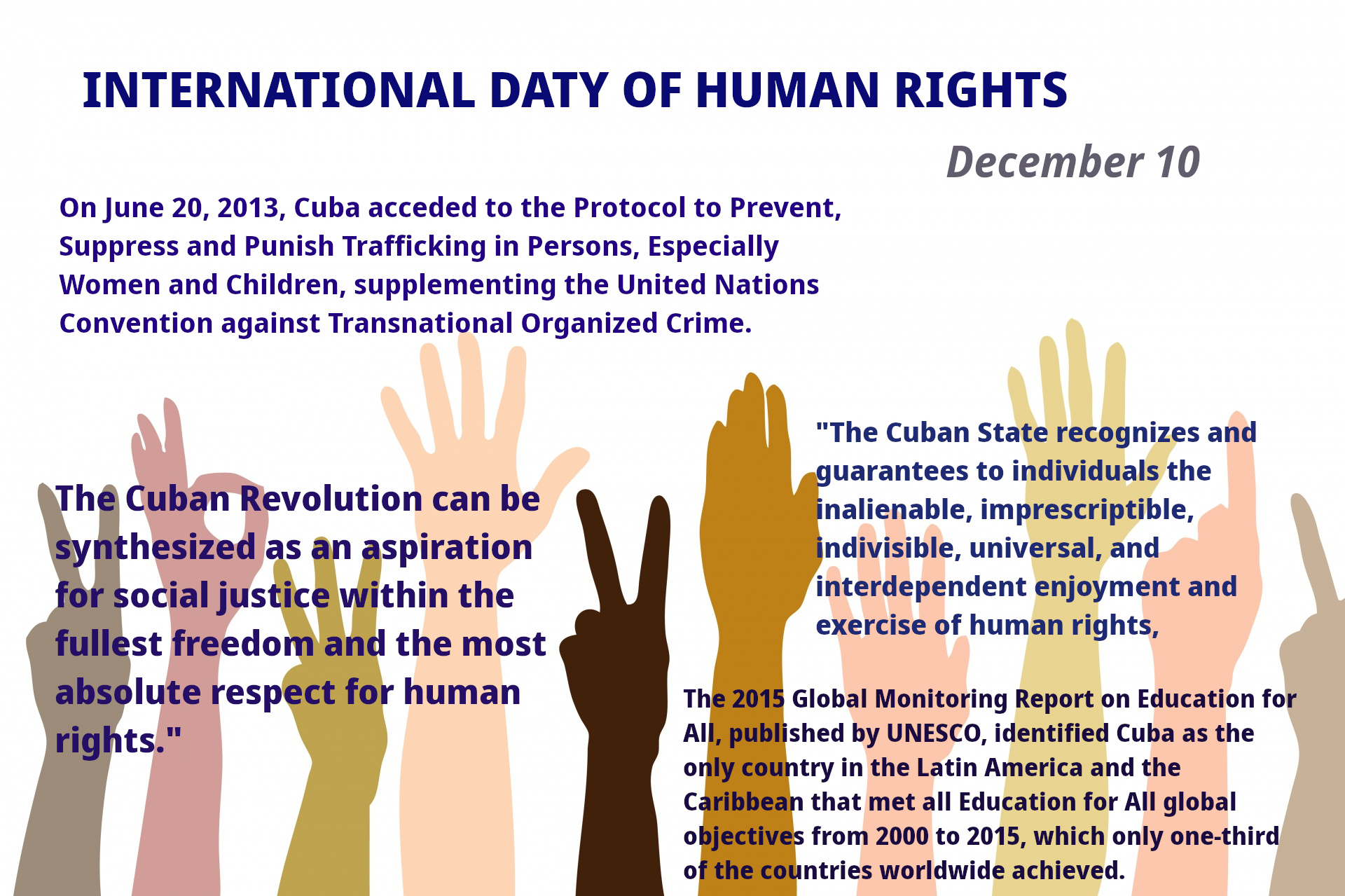
“The Cuban State recognizes and guarantees to individuals the inalienable, imprescriptible, indivisible, universal, and interdependent enjoyment and exercise of human rights, in accordance with the principles of progressivity, equality, and non-discrimination. Its respect and guarantee are mandatory for all.”
While other international actors advocate for predatory wars, coups d’état, and the politicized and selective treatment of human rights against governments that do not align with their hegemonic interests, our nation has ratified 44 out of 61 international instruments in this field, which amounts to 72.13% of the total _, and places it within the group of UN member states with the highest number of ratifications of this type, in accordance with the National Report of the Republic of Cuba to the Universal Periodic Review of the Human Rights Council in 2018.
In the face of the blockade imposed by the United States Government, which violates the human rights of an entire people, Cuba will continue offering its internationalist solidarity cooperation and remaining immersed in the building of a increasingly just, free, democratic, solidary, prosperous and sustainable society, under the guidance of José Martí’s ideal: “I want the first law of our Republic to be the cultivation by Cubans of the full dignity of man, and also under Fidel’s phrase on January 21st, 1959:
“The Cuban Revolution can be synthesized as an aspiration for social justice within the fullest freedom and the most absolute respect for human rights.” Cuba and its commitment to international human rights norms:
Cuba has a long history of cooperating with all human rights mechanisms applied on universal and nondiscriminatory bases.
The country has continued to fulfill the international commitments and obligations acquired under international human rights treaties. As earlier stated, it is a State Party to 44 of these instruments.
On 28 September 2015, Cuba deposited the Instrument of Ratification of Convention No. 182 on the Worst Forms of Child Labor, joining the group of ILO member countries which have ratified the eight fundamental conventions of that Organization.
On June 20, 2013, Cuba acceded to the Protocol to Prevent, Suppress and Punish Trafficking in Persons, Especially Women and Children, supplementing the United Nations Convention against Transnational Organized Crime.
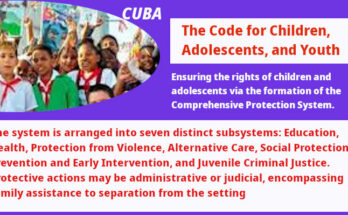
Cuba became a State Party to the Convention on the Rights of the Child in 1991. The Constitution of the Republic proclaimed the equality of all citizens and prohibited discrimination. The Penal Code penalized all forms of discrimination.
Cuba has made significant and internationally recognized advances in the care and development of children and adolescents, as recognized by various United Nations Agencies, Funds, and Programs that work on social issues.
Cuba has continued to improve the quality of healthcare within its system, ensuring universal coverage and free medical aid. According to the World Health Organization, it maintains the highest number of physicians per capita in the world.
The 2015 Global Monitoring Report on Education for All, published by UNESCO, identified Cuba as the only country in the Latin America and the Caribbean that met all Education for All global objectives from 2000 to 2015, which only one-third of the countries worldwide achieved. The report recognized Cuba for its high level of educational development, ranking it 28th globally in its Education for All Development Index.
On October 3, 2019, a new round of Human Rights Dialogue between Cuba and the European Union took place in Brussels, Belgium. The dialogue was conducted within the framework of the Political Dialogue and Cooperation Agreement between the Caribbean nation and the European bloc. Both parties underlined their commitment to the fact that this dialogue contributes to an effective, constructive, and non-discriminatory approach on issues related to human rights in multilateral forums and reinforces the Political Dialogue and Cooperation Agreement between the European Union and Cuba.
ILO Convention No. 141 Concerning Organizations of Rural Workers and Their Role in Economic and Social Development; ILO Convention No. 151 Concerning Protection of the Right to Organize and Procedures for Determining Conditions of Employment in the Public Service; Convention on the Political Rights of Women; Convention on the Nationality of Married Women; Convention on Consent to Marriage.